Ginkgo All-in-One Heat Pump Water Heater — G270 / G300 / G330
Up to an estimated 75% less hot water energy. All-weather performance, all in one unit.
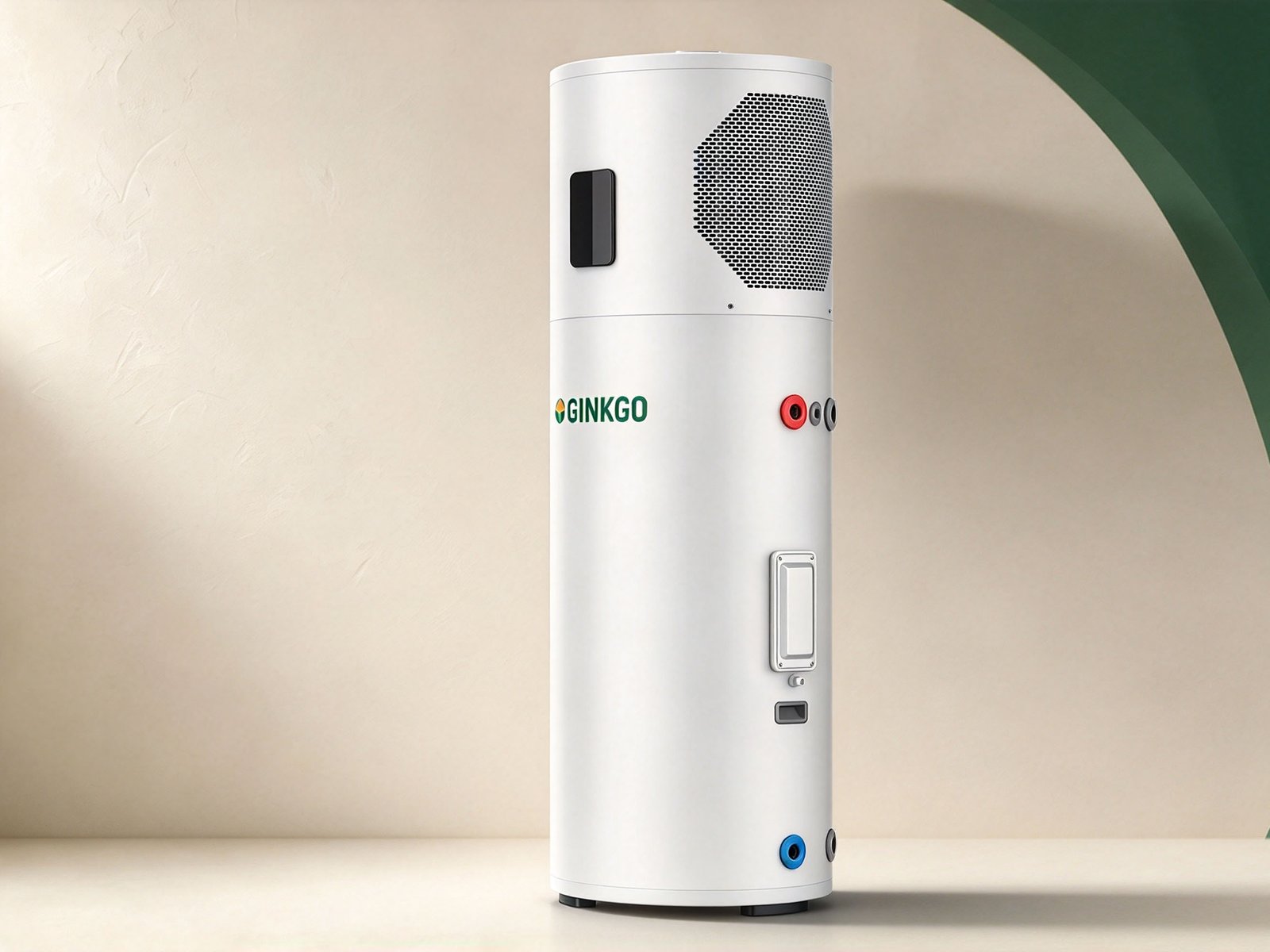
Both finishes are the same model and the same RRP. Your choice is carried through to the order form — confirm stock when we send your invoice.
Hot water that solves the problems you actually have
Choose from 270 L, 300 L or 330 L of storage depending on household size and how much hot water you use at once. The All-in-One suits households that want to move away from gas, families already running solar, and anyone who wants a fixed, predictable hot water bill without a flame on the property.
Take the running cost out of hot water
Hot water is typically the second largest energy cost in an Australian home after heating and cooling. A heat pump extracts free energy from ambient air, using electricity only to move it — saving up to an estimated 75% against electric resistance heating.
Make it work with the solar you already have
The heat pump draws less than 1 kW of electricity for its compressor, so on a typical solar day the majority of its energy can come straight from your own panels.
A stored reserve, then a recovery cycle
The 270–330 litre enamel tank is a storage system: it holds a finite reserve of hot water for the morning rush, and the heat pump then reheats the tank over a recovery period once that reserve is drawn down. Sizing should be based on your household’s peak draw-off and the recovery rate, not on an assumption of unlimited hot water.
Quiet enough for a suburban backyard
At 42 dB(A) the unit is quieter than a raised conversation — comparable to a quiet office. It will not wake the household if it sits near a bedroom wall.
Works through a Victorian winter and a Darwin summer
The unit operates from −7°C to 47°C, with a 1000 W backup element to cover the coldest mornings.
One unit, one install, no split system
Compressor, tank and controls are integrated into a single floor-standing unit. No separate split system to install, no refrigerant pipe runs to route, and one service point for your installer.
Everything the All-in-One delivers
Every feature below is a genuine engineering decision — and every one of them exists to make hot water more reliable, more efficient or easier to live with.
- Up to an estimated 75% energy saving
- R290 natural refrigerant
- 270 L / 300 L / 330 L capacity
- Wi-Fi intelligent controller
- 42 dB(A) sound pressure (measurement conditions to be confirmed)
- All-weather: −7°C to 47°C
- 5-year comprehensive parts & labour warranty (STC installations)
- COP 5.4 published (test conditions pending confirmation)
- Eco and Rapid heating modes
- Touch screen display
- Enamel inner tank
- 1000 W backup element
Three sizes. One system that fits your home.
Every All-in-One Ginkgo Integrated Heat Pump shares the same R290 natural refrigerant and all-weather design. The published COP figure (5.4) is still subject to confirmation of test conditions — simply choose the tank size that matches your household.
| Model | Description | Tank capacity | RRP (incl. GST) |
|---|---|---|---|
| G270 | KRS60A-G270/W270 — All-in-One Ginkgo Integrated Heat Pump | 270 L | $3,350 |
| G300 | KRS60A-G300/W300 — All-in-One Ginkgo Integrated Heat Pump | 300 L | $3,500 |
| G330 | KRS60A-G330/W330 — All-in-One Ginkgo Integrated Heat Pump | 330 L | $3,650 |
Supply only — you arrange your own licensed plumber, gas fitter or electrician for installation. The RRP includes GST but excludes delivery/freight (quoted at checkout), installation, permits and site works. The STC rebate is not included in the price and is claimed separately by an accredited installer. Trade pricing is not published on this site. Prefer an invoice? Request one.
From cold tap to hot water in seconds
No tank, no standby heat loss, no waiting. Here is exactly what happens the moment you turn on the hot tap.
Ambient air gives up its heat
The outdoor refrigerant circuit absorbs heat from the surrounding air — free energy that would otherwise simply sit there.
The refrigerant is compressed
A compressor raises the pressure and temperature of the refrigerant, the same principle as the back of your fridge.
Heat is pushed into the tank
The now-hot refrigerant passes through a micro-channel heat coil inside the storage tank, transferring that energy into the water.
The refrigerant resets and repeats
Having given up its heat, the refrigerant drops back in pressure and returns to the outdoor coil ready to absorb more heat — a closed, continuous cycle.
Full All-in-One specifications
Complete manufacturer specification data, provided so you and your installer can compare apples to apples. Savings figures are estimates, referenced to a conventional electric resistance storage water heater of equivalent capacity under typical Australian household hot-water usage; the result depends on the electricity tariff, climate zone, incoming water temperature, daily draw-off and heating mode (Eco / Rapid or electric boost). They are examples, not guarantees, and exclude the STC rebate.
| Model | KRS60A-G270/W270 • KRS60A-G300/W300 • KRS60A-G330/W330 |
| Finish / colour | White or Silver Grey (selectable above; same RRP, subject to stock) |
| Volume | 270 L • 300 L • 330 L |
| Power supply | 220-240V / 1 / 50Hz |
| Heating capacity (heat pump, thermal output — not electrical input) | 2,650 W |
| Heat pump rated input power | 958 W |
| Electric heater power (backup element) | 1,000 W |
| Maximum input power (total) | 1,992 W |
| Max input current | 9 A |
| COP — published figure, test conditions pending confirmation | 5.4 published by the manufacturer. This figure is not reconciled with 2,650 W output / 958 W rated input at the same operating point; the applicable test conditions and corrected rating are being confirmed. Do not treat it as a verified rating. |
| Sound pressure (measurement conditions to be confirmed) | 42 dB(A); measurement distance, load and acoustic conditions are being confirmed. |
| STC entitlement | Model- and zone-dependent; certificates are created under a 10-year deeming period, which is not a rebate value. See the dated, model-specific estimate (9 November 2026). |
| Refrigerant type / quantity | R290 / 0.45 kg |
| Operating ambient temperature (test conditions to be confirmed) | −7°C to 47°C |
| Maximum tank water temperature (not outlet delivery temperature) | Up to 70°C in heat-pump mode / 75°C with the electric heater. These are tank temperatures; outlet delivery temperature is governed by the tempering valve and site settings. |
| Rated hot water supply | 60 L/h |
| Heat exchanger | Micro-channel heat coil |
| Inner tank material / thickness | Enamel / 2.5 mm |
| Outer tank material / thickness | Galvanised / 0.5 mm |
| Insulation | Polyurethane |
| Net (installed) dimensions, Ø × H | G270: Ø650 × 1900 mm • G300: Ø650 × 2025 mm • G330: Ø650 × 2110 mm |
| Packed (shipping) dimensions | Larger than the net dimensions above — see the installation drawing / packing list before planning access. |
| Installation clearances | Required clearances for airflow and service access are specified in the installation manual; allow for them separately from the net unit size. |
| Net / gross weight | 114 / 134 kg • 126 / 146 kg • 138 / 158 kg |
| Water inlet / outlet size | DN20 |
| Ingress protection (resistance class) | IPX4 |
| Display | Touch screen |
| Solar coil | Without |
| Power cord | 3 × 2.5 mm² |
| Loading quantity (40HC) | 48 pcs |
What to expect on installation day
Good preparation makes for a clean, fast install. Here is what the All-in-One needs from your property.
Outdoor, floor-standing
The unit is floor-standing and rated IPX4 for outdoor installation. Leave the clearances specified in the installation manual so the airflow path is never obstructed.
Plumbed to your home’s hot and cold lines
DN20 water inlet and outlet connections, and a standard 220-240V / 1 / 50Hz supply — your installer will confirm the circuit and RCD requirements.
Room for the airflow to work
The heat pump needs to draw in ambient air and discharge it. Obstructing that path reduces efficiency, so the position matters as much as the unit.
Electrician and plumber, one visit
Because the compressor, tank and controls are integrated, installation is a single unit on a single circuit — with no split-system refrigerant pipe run to route through the roof.
Common questions about the All-in-One
Everything Australian buyers and installers ask us most often about the All-in-One.
How much can I really save with a heat pump water heater?
Against electric resistance heating, the Ginkgo All-in-One saves up to an estimated 75% of the energy used to heat water, because it moves ambient heat rather than generating it. The saving against a gas unit is smaller and depends on your gas tariff, electricity tariff, solar generation and usage pattern — so it is worth modelling against your own bills before deciding. If you already have rooftop solar, the picture is usually considerably more favourable, because the heat pump’s compressor draw is small enough to run largely on your own generation.
What is R290 refrigerant and why does it matter?
R290 is propane, used as a refrigerant in very small quantities — 0.45 kg in this unit. It matters for two reasons. First, R290 has a negligible global warming potential compared with the synthetic HFC refrigerants used in older heat pumps, so it is a genuinely lower-impact choice. Second, the Australian government is phasing down the use of HFC refrigerants, so a unit running on R290 is not the appliance you will need to replace or have serviced in a few years.
Will it keep working in a cold Victorian or Tasmanian winter?
Yes. The unit operates down to −7°C ambient, and includes a 1000 W backup element that supplements the heat pump on the coldest mornings so the tank still delivers hot water. In practice the heat pump does the bulk of the work even in winter — cold air still contains heat; it simply takes a little more energy to extract it.
How noisy is it, and can I put it near bedrooms?
At 42 dB(A) the unit is comparable to a quiet office or a fridge running — quieter than normal conversation. That makes it practical to install near a bedroom wall or a patio where a split system would be intrusive. Your installer will still position it to respect the clearances in the manual, since restricted airflow affects performance.
What is the difference between Eco and Rapid mode?
Eco mode runs the heat pump alone, which is the most efficient way to recover heat and is right for the majority of the time. Rapid mode brings in the 1000 W backup element alongside the heat pump, delivering hot water faster when you need a full tank quickly — after a large family gathering, for example, or ahead of a busy morning. The touch screen display shows which mode is active.
Can I control it from my phone?
Yes. The integrated intelligent controller includes Wi-Fi, so you can check tank status and manage the unit remotely from your phone. For many households the most useful part is simply knowing how much hot water is available before everyone gets in the shower.
Should I choose 270 L, 300 L or 330 L?
Think of it as your household’s hot water reserve, because this is a storage system. A single-person or couple household is comfortably served by the 270 L. A family of three to four, or a household with teenagers using showers in quick succession, is best served by the 300 L. The 330 L is the choice for larger families, homes with multiple bathrooms used together, or anyone who wants a longer reserve before the heat pump needs to catch up. Your installer can size it against your household’s actual usage.
How long will the tank last?
The inner tank is 2.5 mm vitreous enamel and the outer tank is galvanised steel with polyurethane insulation. Vitreous enamel is one of the most durable tank linings used in water heating. The All-in-One carries a 5 Years Comprehensive Warranty on Parts and Labour on qualifying rebate-certificate (STC) installations; other installations follow the standard component schedule. The R290 refrigerant charge and 42 dB(A) sound pressure are also designed to reduce long-term wear on the compressor.
Do I need solar panels to run a heat pump?
No. The unit runs perfectly well on grid electricity alone. Solar simply makes it dramatically cheaper to run, because the compressor draw is well within what a typical residential solar system generates during the day. If you do not have solar, the heat pump still delivers savings of up to an estimated 75% against electric resistance heating.
Is this a heat pump or a heat pump with a tank?
It is genuinely all-in-one: compressor, storage tank and controls integrated into a single floor-standing unit. There is no separate split system, no refrigerant pipe run to route between an outdoor unit and an indoor cylinder, and only one service point. That simplicity is what makes installation faster and the footprint smaller than a conventional split heat pump system.
Ginkgo All-in-One Heat Pump — Installation & User Manual (PDF)
Official 35-page installation and user manual for KRS60A-G270/W270, G300/W300 and G330/W330 — R290 safety, AS/NZS 3500.4 installation, commissioning, operation, error codes, troubleshooting and maintenance. Opens as a PDF in a new tab.
Ready for hot water that just works?
Tell us about your property and hot water habits, and we will match you with the right All-in-One and a licensed installer in your area. No obligation, no pressure.
Other Ginkgo hot water systems
Not sure which size fits your household? Compare the rest of the range below.

Ginkgo G26 Continuous Flow Gas Water Heater
The Australian family favourite. 26 litres a minute, no cold run-out.

Ginkgo G30 Continuous Flow Gas Water Heater
30 litres a minute at a 25°C temperature rise. Continuous hot water on demand for large Australian homes.

Ginkgo G22 Continuous Flow Gas Water Heater
Compact efficiency. 22 litres a minute for units, townhouses and 1–2 bathroom homes.